Showing posts with label taxes. Show all posts

Mar 14, 2022

Sharing Your Home Sales Price - Do or Don't?


Texas homebuyers quickly find their new mailboxes filled with solicitations and requests after their purchase. They are also overrun with appeals and demands for information regarding the purchase of their property.

In addition to the sham mortgage insurance offers and tax filing service scams are enticements to disclose the sales price of their property. Most of these communications look very official and it can be hard to decipher what is legitimate and what is not. Almost none of it is.

Texas is a non-disclosure state

In Texas, a buyer or seller is not required to disclose the sales price of a property to anyone or any entity whatsoever. Real estate sale prices are not public record.

In most states, you can look up any address through the county property tax appraiser to see the most recent sales price. The public has access to sales prices in 38 states. In some states, the public disclosure of real estate sale prices may be printed in local media or appear on the publicly recorded deed. In other ‘disclosure’ states, only governmental entities have access to the sales price.

Our state considers a property sale to be a private transaction and you have a right to keep the details away from curious folks as well as government agencies.

With whom should you share your sales price?

There is no law that says the state, county, city or appraisal districts can require you to provide your sales price. Nosy neighbors and relatives may also ask or speculate about what you paid for a property. It is nobody’s business.

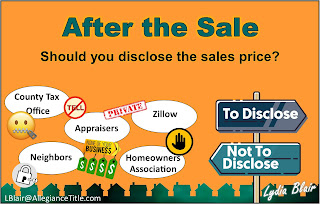
You do not need to disclose the purchase price to the County Tax Office, your HOA, an appraiser, prying neighbors or anyone else. Your tax accountant is the only person with whom you should share the purchase price of a property.

Why does the County want to know?

Many Texas appraisal districts want full disclosure of real estate sales prices to help establish the taxable value. Texas has no state income tax. Our high property taxes help make up for that. Texas property taxes are assessed and paid by counties, cities, schools, appraisal districts, etc. The total property taxes average about 3% of the assessed value of the property each year. If your tax assessor has your actual sales price, they will usually base your taxes on that price.

Zestimates & Other guessers

Web sites like Zillow attempt to place a “home value” on a property based on different formulas. The estimated sales price and value posted on most web sites are inaccurate. These automated valuation models include limited information gathered from publicly recorded mortgage liens, tax assessments and geographic maps.

Their estimates do not include actual sales prices or take into account data such as negotiated concessions, repairs, closing costs, etc. that one of the parties may have paid. They do not take into account lot sizes, condition of the property, etc. Only licensed Realtors and Appraisers have access to all of this information.

Who really knows the sales price?

The buyer, seller, agents, title company and mortgage lender all know the sales price of a property. If a property is for sale in the Multiple Listing Service (MLS), then the listing broker must report the sale and sales price to the MLS. The MLS collects and maintains this proprietary information.

Property owner information, not sales price, is public information. Marketing and sales companies scour county records every day and collect information on deed transfers and filing of mortgage liens. That is where they find the addresses of new homeowners to solicit. A lot of the junk mail will also come from folks who find you when you turn on your utilities. That is also public information unless you request that that the utility provider make it private.

How to reduce requests

What should you do when faced with an official request asking for the details of the sale? Ignore it. There is enough information out there about all of us already. In my opinion, no one should offer up this additional financial and personal information voluntarily.

[where: 75230]

Feb 3, 2022

Real Estate & Money Laundering


Criminal activity in both residential and commercial real estate is going strong. The U.S. has become a “safe haven” for money laundering with real estate investments leading the way. 

The figures are “staggering” according to a recent report from Global Financial Integrity (GFI), a Washington-based research institute that studies the movement of illicit finances. They report that billions of dollars were laundered through U.S. real estate between 2015 and 2020.

Drug dealers, arms traders, terrorists, and other criminals typically acquire these funds from illegal activities and seek to hide their source. These are not small-time crooks. Some are anonymous shell companies or complexly structured corporations.

Most cases concerning real estate and money laundering involve money from abroad. Some come from political figures who have “plundered, looted, and laundered the assets of their home countries,” according to the GFI report. The report cites cases of millions laundered by investors from Russia, the Ukraine, Venezuela, and Equatorial Guinea. In one example, a Beverly Hills property was purchased with $100 million embezzled from Kuwait’s Department of Defense. 

The GFI report states that real estate money laundering problems expand outside of luxury markets and big cities. They also occur in remote towns, suburbs, and rural areas. Residential properties are popular with money launderers, but commercial properties are an easy target as well. Income-producing commercial properties often carry a higher value and include hotels, offices, condominium developments, and retail centers.  

An assortment of professionals such as attorneys, real estate agents, and title agents assist these criminals “either through willful blindness or direct complicity” reports the GFI. Monitoring and enforcement of this type of illegal activity “nose-dived” during the previous government’s administration.

The report reveals that the current U.S. approach to residential real estate money laundering — using geographic targeting of certain counties — is inadequate. Currently, commercial real estate is not subject to any federal disclosure requirements to discourage money laundering.

What are the Feds doing about it?

As a core national security issue, the current White House administration issued a National Security Study Memorandum earlier this year to counter these criminal efforts. The purpose is to make it more difficult for money launderers and criminals to conceal their activities.  Directed at criminal organizations and individuals, the aim is to bolster the government’s ability to combat corruption and to freeze and recover stolen assets. 

The Treasury Department is under pressure from the president to repeal the regulatory exemption for real estate agents, who are not required to identify their clients or to report suspicious activity at this time. The U.S. is the only major member of the G7 that does not require real estate professionals to adhere to money laundering rules.

The Justice Department will continue to review evidence of financial crimes and expects to increase both the number and scope of monitoring activities. These enforcement actions should put significant impediments on these financial criminals.

What are title companies doing to help?

Title insurance companies are required to report suspicious activity, but the details for doing that are vague. In certain areas (including Dallas and Tarrant Counties), title companies must file reports to the Financial Crimes Enforcement Network (FinCEN). This organization is part of the U.S. Department of Treasury and aims at reducing criminal purchases.

Currently, title companies must identify and report persons purchasing residential properties over $300,000 with cash and under the name of a business, LLC, or other legal entity.

The Texas Department of Insurance prohibits title companies from accepting certain forms of payment for the purchase of real estate to help protect against crime and fraud. Funds must be delivered by wire transfer, cashier’s check, certified check, money order, or personal check.

All title companies are legally required to report any cash or personal checks for a purchase that total more than $10,000 to the IRS. This is designed to discourage money laundering, tax evasion, and other illegal activities. Seems like it hasn’t slowed down the big criminals.

Hopefully, change is on the way
[where: 75230]

Oct 6, 2021

Texas 2021 Real Estate Legislative Update 2.0

A little property tax relief is coming for some Texas homeowners. Two minor property tax bills were approved at the Texas Legislature’s August 2021 Special Session. With some of the highest property tax rates in the country, most homeowners welcome any law that provides Texans a tax break.

New Homeowner Homestead Exemption

Under current law, when someone purchases a home, they must wait until January 1 of the following year to receive the benefit of a homestead exemption. This new law allows a homebuyer to receive their homestead exemption in the year that they acquire the property, rather than having to wait for January 1 of the following year.

Starting in January 2022, new Texas homeowners who qualify for a homestead exemption will become immediately eligible to receive a property tax reduction when they purchase their property. Those buyers will receive the exemption allocated proportionally from the time they purchase the property. For example, if the buyer purchases the property in February, they will receive the homestead exemption on that year’s tax bill for February through the end of the year.

Texas homestead exemptions from counties, schools, cities, and special districts reduce the property taxes for the homeowner. The amounts vary from county to county. All Texas homesteads receive a $25,000 exemption on their home’s value from school property taxes. Other local entities, like cities and counties, offer a separate residence homestead exemption. A homestead exemption can typically save a homeowner 10%-20% on their property taxes.

Senior and Disabled Exemptions

The Texas Legislature passed “an Act relating to the reduction of the amount of a limitation on the total amount of ad valorem taxes that may be imposed by a school district on the residence homestead of an individual who is elderly or disabled to reflect any reduction from the preceding tax year in the district’s maximum compressed rate and to the protection of school districts against the resulting loss in local revenue.”

That’s a mouthful of legal jargon. Essentially, this legislation proposes a reduction in school taxes for seniors and disabled Texans. It would extend the school property tax rate cuts approved by the Texas Legislature in 2005, 2007, and 2019.

School property taxes for homeowners who are at 65-plus years old or who are disabled are frozen at the amount owed in the year they qualify. However, when some school districts reduced their tax rates, those homeowners did not see a reduction in their tax bills due to this frozen value. The new law would reduce the frozen value by the same percentage as the reduction in a school district’s tax rate, starting in the 2023 tax year.

Because there are different property tax laws for Texas elderly and disabled property owners, reforms to their tax rates must be made by constitutional amendment. Texas voters will need to approve this on local election ballots in 2022. If approved, the amendment to authorize this tax cut would take effect in January 2023.

Texas Property Taxes

No one likes to pay taxes and Texans don’t like hearing that our property taxes are higher than most other states. However, we do not have state income taxes like many other states. Texas counties set their own property tax rates, and they vary across the state. Counties with smaller populations tend to have lower property taxes. The average property tax rate in Texas is 1.8 percent of the property’s appraised value.

[where: 75230]

Oct 3, 2021

Texas 2021 Real Estate Related Updates


Real estate topics took a back seat to big issues like the pandemic and power grid failures in 2021 with the Texas Legislature. Of the 3,800 bills enacted into law, real estate still got a little attention. Some of the welcome changes coming next week are due to lobbying efforts from the Texas Association of Realtors and the Texas Land and Title Association. New real estate contracts reflecting these laws are now available and are required to be used by Realtors starting September 1, 2021.

Homeowner Associations 

The law from Senate Bill 1588/House Bill 3367 requires more transparency from HOA management companies. It puts a cap on the costs for obtaining subdivision information, resale certificate updates, and HOA transfer fees. The limit for the fee to obtain subdivision information will be $375 and the fee for an updated resale certificate is topped at $75. 

The new law also states that the HOA’s publicly filed management certificate must disclose the amount of any transfer fees charged with the sale. That information will be made available in the Texas Real Estate Commission (TREC) database. This will allow agents to look up the transfer fees on a property prior to listing it for sale or submitting a purchase offer for their buyer. It offers protection to homeowners and buyers against unreasonable fees and surprises. Additional consumer privacy protections for homeowners are included in this new law. 

Effective September 1, 2021, the law is being phased in. TREC will establish a database to accept management certificates from HOAs and make it available to the public by December 1, 2021. HOAs must electronically file their management certificate with TREC no later than June 1, 2022. 

Unfortunately, some HOA management companies (and companies that provide HOA resale certificates and documents) have already found a way around the new law limiting their fees. A resale package from Condocerts.com last week included a transfer fee (normally paid at the time of closing) and a processing fee. Instead of $375 for the resale package, the upfront cost to the seller was $650. Fortunately, we had enough time to avoid their outrageous rush fee.

Public Improvement Districts (PIDs) 

House Bill 1543 is now a law that requires a property owner in a PID to disclose that the property is in a PID and certain details of the PID prior to executing a contract with a buyer. The PID notice must be acknowledged by the buyer and seller and will be recorded in county records at the time of the sale. A PID is a special district created by a city or county. It allows a special assessment tax against properties within the district for improvements or maintenance. The existence of a PID on a property can currently be found in the county appraisal district tax records. More details of a PID must now be filed with the county deed records starting September 1, 2021. 

Appraisers 

House Bill 2533 specifies that unless a lender requires a full appraisal for a financial transaction, a licensed appraiser is not required to comply with Uniform Standards of Professional Appraisal Practice (USPAP) when performing an evaluation. If an appraiser performs an evaluation that is not in compliance with USPAP, then it must include a notice stating that the evaluation is not an appraisal performed in compliance with USPAP. This takes effect on June 14, 2021. A new Statute of Limitations law from House Bill 1939 provides for a two-to-five-year limit for lawsuits filed based on an appraisal or appraisal review. This excludes lawsuits based on fraud or breach of contract and is effective September 1, 2021. 

Quitclaim Deeds 

Transferring title in Texas with a Quitclaim Deed should become easier after September 1, 2021. This law will allow a purchaser of a property with a Quitclaim Deed to be considered a bona fide purchaser if at least 4 years have passed since the deed was recorded. Title companies are wary of quitclaim deeds because, unlike a warranty deed, they only convey whatever interest the signer may or may not have in the property. The signer of a quitclaim deed may have limited or no ownership of the property. There is no warranty of full ownership being transferred. This new law may remove quitclaim deed concerns if at least 4 years have passed. It does not affect quitclaim deeds recorded prior to September 1, 2021.

Mechanic’s Liens 

A new law extends the description of lien rights. Subcontractor liens must now be filed within a particular time period and notice requirements are detailed. Limitations for filing suit to foreclose a lien and who must be licensed to file a lien are now updated. 

Judgments on Homestead Properties 

Using a homestead affidavit to remove a judgment on a property just got clarification. Previously, a homeowner seeking to remove a judgment in order to sell or refinance would sign a homestead affidavit, send it to the creditor, wait 30 days and see if the creditor disputes the homestead claim. The new law allows the owner to sign a homestead affidavit and record it with the county at any time. The creditor is still notified of the recording and has 30 days to dispute it, but the homeowner can get the affidavit and issue of homestead resolved ahead of a transaction. 

 Racial Restrictive Covenants 

Some older subdivisions in Texas have original restrictive covenants regarding certain racial or ethnic groups. These have been invalid and unenforceable for decades but they still show up in the county records as legal documents. This new law allows a property owner to request that the County Clerk actually remove the language of the racial restrictions from the public record. The county would remove the document and attach another document stating that a restriction that is void has been removed. While a good concept, this law just changes the county paperwork. 

Freedom of Expression 

House Bill 3343 prohibits insurers (like title insurance or homeowners’ insurance) from discriminating on the basis of political affiliation or expression. 
 And if the rules of real estate are driving you to drink, then you may have notice House Bill 1024. Restaurants may start including alcoholic beverages in delivery and to-go orders. It has no effect on real estate transactions but cheers to that law anyway.
 [where: 75230]

Nov 27, 2020

Drawing the line - Texas Counties


One might think that a home in the city of Dallas would naturally also be located in Dallas County. And one would wrong. 

Your home may be located in Dallas and likewise in Collin, Dallas, Denton or Rockwall County. For many people in Dallas-Fort Worth, their next-door neighbor could be in a different county. The folks across the street might be in a different school district as well. 

Convoluted boundaries can make for some interesting scenarios of where the kids go to school, who your elected officials are, which police department you call, and where you register your car. Texas has 254 counties, more than any other state. We also have more incorporated cities and more school districts than any other state. 

Imagine a map of D-FW counties, overlaid with city borders, and then place the school districts on top of that. Try not to get cross-eyed.

There is a reason county, city, and school district boundaries don’t match up. When the Republic of Texas was established, boundaries of counties were vague and not precise. Rivers or creeks often defined them. Eventually the Texas Constitution set out policies to establish more consistent size and shape for new counties. The rules evolved into county sizes of about 900 square miles with the goal to be as square as possible. Ideally, the county seat is located near the center of the county. 

When it comes to town and city limits, many area municipalities have consolidated or split over the years. Often the reasons are economic. Texas school districts are independent and do not necessarily follow city or county borders. Over time, some school districts might have merged into one, while others split into unique entities. These actions have resulted in boundaries that look like a jigsaw puzzle.

Several DFW subdivisions lie within two counties. When the neighborhood was developed from farm and ranch land, county representatives decided where to draw the lines between neighbors. They agreed on who would claim which homes – and who would tax them.

Why does this matter? While your county tax assessor may collect your property taxes, you actually are paying property taxes to your county, city, and school district. Often the county collects all of your property taxes, making it easier to pay with one payment. However, that is not the case in every county, city, or school district. 

Many Dallas area homeowners write two or more checks to different entities for their property taxes each year. Your taxing authorities determine more than who collects your taxes, the location of your local library, or the identity of the local dogcatcher. The county that collects your taxes also maintains your property records. They record your deed and keep ownership records.

Your county is where you look for information about a piece of real estate. When you need to know more, just follow the money. The sheriff may not pursue you past the county line, but the school, city, and county tax collectors will.
[where: 75230]

Mar 9, 2020

How Prorations for Real Estate work

At closing, some items, like real estate taxes, are divided up between the buyers and sellers so that each party pays their share of the expenses. This is called proration. The amount each party pays is based on the number of days in the year (or month) that they own the property. It is only fair that you are charged ownership fees and taxes just for the time you own the property.

The title agency is typically responsible for dividing these kinds of expenses proportionally based on a unit of time. For annual property taxes, we divide the tax amount by 365 days to obtain the cost per day. We then multiply the cost per day by the days the seller owned the home and the days the buyer will own the home. Each party is responsible for their prorated amount.

If the taxes for that year have not been paid, the seller is charged for their share and it is credited to the buyer to pay the total bill. If the seller has already paid the taxes for that year, the buyer is charged for their share and it is credited to the seller at closing.

Of course, property taxes aren’t the only fees that are prorated …


Monthly expenses, like HOA dues, are based on that HOA’s billing cycle. For example, let’s use a closing on Feb. 20 for a property that has monthly HOA dues of $280. This would represent dues of $10 a day. The buyer would be charged $80 for the 10 days they will own the property (February 21-28) and the dues are paid to the HOA on their behalf for those 10 days. That amount is added to what they will pay at closing.

In this scenario, if the seller had paid their February HOA dues, they would receive a credit of $80 at closing for February 21st through February 28th. This would be a credit for the expense they paid for a time they no longer own the property. If the seller had not paid their dues, they would be charged $200 for their share of the February dues (plus any late fees) and the title company would pay the HOA the February dues on their behalf.

Some prorations can be based on actual amounts – like rents and HOA dues. However, tax prorations are often based on estimates because the actual tax statement for that year has not been determined. The amount being prorated will typically be based on the previous year tax statement. The title company will usually require both buyers and sellers to acknowledge that if the actual tax bill comes out differently, they will settle it between themselves.

Prorations are addressed in Paragraph 13 of the TREC residential contract. It states:

“Taxes for the current year, interest, maintenance fees, assessments, dues and rents will be prorated through the Closing Date. The tax proration may be calculated taking into consideration any change in exemptions that will affect the current year’s taxes. If taxes for the current year vary from the amount prorated at closing, the parties shall adjust the prorations when tax statements for the current year are available. If taxes are not paid at or prior to closing, Buyer shall pay taxes for the current year.”

If, as a buyer or seller, you have any questions about your fair share of monthly, quarterly, or yearly expenses, just ask your title agent for the details.
[where: 75230]

Feb 24, 2020

Dealing with an IRS Lien on a Property

If you’re in debt to the IRS, good old Uncle Sam may put a lien on your property. And he isn’t going to let you sell your home without paying that lien.

When someone has a federal income tax lien filed against them, the debt attaches to all of their property, which includes their homestead. Federal income tax liens (also known as IRS liens) are called Super Liens. That basically means you can be super sure they’re going to collect the money owed them when the house sells.

Any and all liens against a property must be released when a house is sold. Most homes have a mortgage lien attached to them. At closing, the title company collects the buyer’s funds due for the purchase. Those funds usually come from a lender and the buyer.

The title company then pays off the liens against the property and gives the seller their share of the proceeds from the sale. The title company helps ensure the buyer is getting the property clear of prior liens.

What if the IRS lien is more than the seller will make upon selling the property? Perhaps the funds from closing aren’t enough to pay off the tax lien.

If the equity in the home after paying all mortgages, commissions, closing costs, etc. is not enough to pay the income tax lien in full, then the seller will need to apply for a Certificate of Discharge from the IRS. They must complete an application and include all information concerning the sale. This must include the sales price, all contractual agreements, payoffs of existing mortgages, itemized closing costs, an appraisal, and a third-party price opinion. It is a detailed process.

Once all required information is complete and the application is submitted to the IRS, the feds will take 45-60 days at a minimum to review it. The transaction cannot close until the IRS approves the transaction and provides a Certificate of Discharge.

Title companies usually suggest that all parties allow 90 days to secure a Certificate of Discharge. If the seller is slow to obtain the required information or submit everything, the process can be longer.

A Certificate of Discharge only releases that particular property from the IRS lien. It does not release the debtor from their personal liability to remaining back income taxes. The debtor is still responsible for the remainder of any debt owed.

Uncle Sam wants to make sure you pay your income taxes. And an IRS lien will help ensure that happens.

Opinions expressed are of the individual author for informational purposes only and not legal or tax advice. Contact an attorney or accountant to obtain advice for any issue or problem.
[where: 75230]

Mar 15, 2019


Remember privacy? It’s what most Americans enjoyed a few decades ago. Today, it’s elusive and rare. It’s simple for any of us to find just about anyone with a few clicks on a keyboard.
In an effort to reduce the solicitations for carpet cleaning, bogus tax filing services, mortgage insurance scams and such, I tried to make the information on my recent home purchase a little more private. The result was somewhat effective. 

How do these companies and salespeople find out you’ve purchased a property? It’s highly unlikely that they got it from the title company or real estate broker. We don’t share information with third parties unless we must. Government entities are about the only ones we disclose details. 

However, property owner information is public and online in Texas. Our county tax appraisal sites allow people to search the owner of a property by property address or owner name. It’s pretty hard to make your ownership information private on those county web sites. But, I’ll explain how below.

County web sites aren’t typically the source for the first wave of solicitations. The updating of owner information on public county web sites can take months. 

Most of the junk mail will first come from folks who find you when you turn on your utilities. That’s the first line of defense for your privacy.

1.    Place privacy on all of your utility accounts. That includes water, gas, and electricity. Chapter 182 of the Texas Utilities Code (subchapter B) requires public utility companies to make your personal information confidential if you request it. It may involve filling out a form, but it will keep the public (and scammers) from obtaining your address, phone number and social security number.
Call or look up your city’s utility provider and ask how to do this. In Dallas, the form to make your water account confidential is: https://dallascityhall.com/departments/waterutilities/DCH%20Documents/pdf/Confidentiality_eng.pdf

Atmos Energy provides gas service to Dallas and a quick phone call to them gives you the opportunity to place a passcode on your account to prevent your information from being shared with third parties.  For confidentiality on your electric account, contact your electricity service provider.
 2.    Request confidentiality on your mortgage account. Most mortgage companies (or mortgage servicing companies) will share or sell your information with “affiliated or non-affiliated third parties” for purposes of offering you additional products. You can ‘opt out’ of allowing them to share your personal information. Just contact them. 

3.    Become one of the select few to make your information private on your county appraisal and tax sites. There are basically three ways to do that. 
  • Work as a judge or peace officer. These folks may omit their residence address in lieu of the courthouse address where they serve.
  • Show proof that you are a certified participant in the Address Confidentiality Program (ACP) for victims of family violence, sexual assault or stalking.
  • Create a trust or entity and place the property under that name instead of your own.
[where: 75230]

Feb 1, 2019

Getting a Texas Homestead Exemption


A reader writes: “I bought a home in 2018 and my taxes are escrowed by my mortgage company. How do I get a homestead exemption to get a discount on my taxes? Do I need to repeat the process every year? How much does it save me?” 
You most definitely want to know how to file for a homestead exemption for your 2019 property taxes. To get a homestead exemption, you must own and live in the property as your principal residence as of Jan. 1 of that tax year. So, if you purchased in 2018, you may apply for that exemption after Jan. 1, 2019. 
A homestead exemption removes part of your home’s value from taxation, so it lowers your taxes. I don’t know the details about your home to tell you how much a homestead exemption can save on your property taxes, but it is generally about 20 percent. Given the property tax rates in Texas, it is worth the few minutes it takes. 
To qualify, your home must also be owned by you as an individual (or individuals). A corporation or other business entity doesn’t qualify for this exemption. Do not pay someone else to do this for you. It is free and you can do it online in a few minutes. 
Here is a step-by-step guide for how to apply for a homestead exemption in the DFW area: 
  • First you need to change the address on your driver’s license to your new home address. You may do that online as well for a fee. You’re going to need to submit a copy of your driver’s license or Texas ID card that shows the same address as the homestead property. Take a photo of it or scan it to upload with your online homestead application. 
  • Go to the appraisal district web site for your county appraisal district. Property tax sites for the DFW area include: Dallas County Appraisal District, Tarrant Appraisal District, Collin County Appraisal District, Denton County Appraisal District and Rockwall County Appraisal District. 
  • Find your property on the appraisal district site and open that page to show your account. There should be a choice for forms or exemptions. Just find the link and click on it. 
  • Follow the directions for filing your exemption and fill out the online form. You’ll need to upload that copy of your driver’s license. Without it, the application will be denied. But it is quick and easy. 
You will only need to do this one time for the property you are currently occupying. Once you receive the exemption, you don’t need to apply again unless for some odd reason the tax assessor asks you to repeat the application. 
The deadline to apply is April 30. But don’t procrastinate — do it now. 
The homestead exemption is only good for a property that you own and occupy as your principal residence. If you own more than one property, the tax folks will only allow you the one exemption. 
Look for your property tax notice in May. Your property taxes are determined by (1) how much the appraisal district says it is worth, and (2) the tax rate that your local government entities set. Those entities include the county, city and school district. 
If the assessed value is more than what you paid, you may want to protest the value. Instructions for protesting are included with your tax notice. 
The opinions expressed are of the individual author for informational purposes only and not for the purpose of providing legal advice. Contact an attorney to obtain advice for any particular issue or problem. [where: 75230]

Nov 3, 2018

It's October Tax Season


For most North Texas homeowners, the 2018 tax statements are out. You may not have received your bill in the mail, but your tax bill is out and due for payment by Jan. 31.

Simply go online and search for your county tax assessor to get your statement before it arrives in the mail. For Dallas County, you can find your statement here.

You’d think property tax bills would be fairly direct: “Here is the property address, here is the tax bill.” But these are government entities. So, let’s see how complicated it really is.

We’ll use Dallas County as an example. In Dallas, you might have Dallas County taxes, Dallas city taxes, hospital district taxes, community college taxes, and school district taxes. You write one check to the tax assessor for the total bill.

But you could live in Dallas County and have Richardson ISD, Irving ISD, or Highland Park ISD taxes instead of Dallas ISD. You might pay taxes to the City of Farmers Branch or DeSoto instead of the City of Dallas. There are various combinations of taxing entities in every county of North Texas.

Here’s where it starts getting complicated. The 2018 Dallas County taxes are posted — except for Dallas ISD. Those won’t be finalized until after the election on Nov. 6. A few other entities here and there haven’t posted their 2018 tax bills as well. And we don’t know exactly when they will post them. It might be tomorrow, it might be in two weeks. A property owner doesn’t have a correct amount due until the tax statement is released by their tax jurisdiction.

This wouldn’t matter much if title companies didn’t have to prorate taxes between buyers and sellers and give accurate tax information to mortgage companies. To explain:

Typically, when you sell your property, the title company pays off your mortgage and other liens from the proceeds of the sale. They also prorate the current year taxes between buyer and seller. For example, if you owned your home 100 days in 2018, then the title company would withhold 100 days of property taxes to be used to pay the taxes at the end of the year. Typically, this amount is charged to the seller and credited to the buyer on the closing statement. But that changes this time of year.

Understandably, mortgage lenders want assurances at closing that there are no unpaid taxes on the property. Title companies issue title insurance that includes endorsements to the lender that there are no outstanding ‘due and payable’ property taxes. It’s part of their job to verify payment of taxes and issue title insurance accordingly.

Let’s take a step back and look why this is so important. In Texas, unpaid property taxes can cause huge issues. The main issue being foreclosure on the property if the taxes aren’t paid.

Remember what I said earlier? Your 2018 tax bill is out and is now due and payable. Or at least part of your tax bill is out and is now due and payable. It depends on where you live. Those taxes that are posted are collected and paid at closing.

It’s not too difficult to prorate those between buyer and seller. But the taxes that haven’t yet been posted (like DISD taxes) fall into a separate category and must be handled differently. How those are handled depends on the mortgage lender, the title company, the buyer and seller.

Title companies and mortgage companies are updating closing statements daily based on available tax information as it comes out. Payments made to tax authorities should be based on actual tax statements, not estimates from previous years. If the wrong amount is paid, then who owes more, who get a refund, etc. can become a problem. Refunds are sometimes issued only to who made the payment – the title company. The title company must then determine who gets the refund – we can’t keep it. The bigger issue is collecting if the actual amount owed is more.

That makes for some challenging dynamics when it comes to buying or selling a home this time of year.

Everyone wants assurances that those ‘due and payable’ property taxes are being paid. That requires the title company to collect and pay the property taxes at closing or show proof that the taxes have been paid. That proof must come from the tax office.

The title company and the buyer’s mortgage company rely on a Tax Certificate to show the status of the property taxes owed. If the tax certificate shows a balance is due, then it must be paid at closing.

But wait, there’s more!

Let’s say you’re one of those homeowners that doesn’t like to deal with those pesky property taxes so you have them escrowed and paid by your mortgage company. In that case, your share of the unpaid 2018 taxes will still be withheld from your proceeds at closing and paid on your behalf by the title company. Because most likely, the mortgage company hasn’t paid those taxes yet. And when your sale closes and the loan is paid off, they may not pay those taxes. The title company must ensure they get paid. Your mortgage company will refund the amount in your escrow tax account after closing.

Couldn’t the seller simply pay their tax bill prior to closing and give the title company a receipt as proof of payment? No. We must have an updated tax certificate that shows a zero balance for taxes. Otherwise, a seller could make a tax payment by check or credit card, obtain a receipt from the county and then stop payment on the check or dispute the credit card charge.

For the folks buying or selling their properties right now, it requires communicating with the title company and their lender to alleviate surprises at closing. Many sellers don’t expect to pay their share of the taxes at closing when they are already being escrowed by their mortgage company. Likewise, some buyers don’t want to be surprised to find they must bring more funds to closing to pay their portion of the 2018 taxes now. But these scenarios are common.

It can be a taxing time of year for buyers, sellers, lenders, and title companies.

The opinions expressed are of the individual author for informational purposes only and not for the purpose of providing legal advice. Contact an attorney to obtain advice for any particular issue or problem. [where: 75230]

Oct 6, 2018

The Texas Property Tax Cycle


We’ve all heard about the two things you can’t avoid – death and taxes. Just like there is a life cycle, there is a property tax cycle. The tax cycle is a lot easier to predict.
This life cycle of property taxes follows the same pattern every year. If you’re a Texas homeowner, your property is somewhere in this predictable rotation.
I offer you a synopsis of the tax collection cycle. Follow along with the snazzy graph I made from information from the Texas Tax Code.
January 1 – The start of a new property tax year. The owner of the property as of January 1st is personally responsible for taxes that year. Tax assessments and exemptions are typically based on the status of the property and ownership as of January 1st.
Spring – is ‘appraisal’ time. Actually, I’d call it ‘taxable value’ time. Because the value according to the tax district is not always the same as a genuine appraisal. Nonetheless, this is when tax districts determine the taxability and value of properties. Exemptions need to be on file by April/May.
Notification – Taxing districts must notify property owners of their appraised value by either April 1 or May 1 (depending on the type of property) or “as soon thereafter as practicable”. According to the Texas Property Tax Code, if there is no change in your tax position then they don’t have to notify you. I’m looking forward to the year that I don’t get a notification or increase in my assessment.
Summer Protest Time –  They call this ‘equalization’ down at the tax office. It’s when you can protest the value they place on your property. After protest time is over, the value of the property is set for the next year.
Tax Rates Set – The local taxing authorities set the rates. This is different from your property value. The rates are based on how much money the local government, schools, etc. need and/or want. Rates can go up or down. Typically, when property values go up, the tax folks don’t need to raise the rates because their revenue will automatically go up. If property values are flat, then they may raise the rates to increase revenue.
October 1 – tax bills go out to property owners. That is also when the bills are payable. In some areas you can get a discount by paying your taxes at this time.
January 31 of the next year – Previous year taxes are due. If you got your 2018 tax bill in October, it is due by January 31st 2019. Aren’t we lucky that we don’t have to pay our tax bill in advance? I’m trying to find the bright side here. 
February 1 – Previous year’s taxes become delinquent. Late fees start accruing.  If they aren’t paid by July, they are turned over to a collection agency. And like death, there is no getting out of paying your taxes.
The opinions expressed are of the individual author for informational purposes only and not for the purpose of providing legal or tax advice. Contact an attorney or accountant to obtain advice for any issue or problem.
[where: 75230]

Sep 29, 2018

The Pain of Unpaid Property Taxes

Property taxes are the talk of the town right now. Municipalities all over the Metroplex are proposing tax rate increases on top of the frequent increase in property values. This year’s tax bill may be a double whammy for our already steep homeowner taxes. If you’re thinking of avoiding those taxes, here is your warning. 
“Texas is pretty efficient with collections or foreclosing because our property taxes are high,” says Mary Doggett, VP of National Investors Title Insurance.
Despite our strong homestead rights in Texas, you can lose your home if you don’t pay your property taxes. Rest assured that the taxing authorities will collect their money one way or another. There is no escaping it.
“This a topic we face often in the title industry,” says Doggett. “Property taxes are the No. 1 cause of losses for the title business in Texas.”
That’s why title companies diligently research property tax records and potential tax liens on every sale. Unpaid property taxes collect penalties and fees quickly. And we want to ensure they are paid when the property transfers ownership.

“A property tax lien is a Special Priority Lien. They take priority over almost all other liens,” says Doggett. Whoever owns the property on January 1st of that year, is liable for the taxes for that year.
From a taxing authority prospective, a new owner isn’t responsible for previous years taxes. However, a tax lien runs with the land. That means the tax lien attaches to a property and stays with it – regardless of ownership – until the taxes are paid.
A tax lien can remain on the property even if the ownership changes. That shouldn’t happen if you use a title company to handle the transaction.
If you’re over 65, you may be eligible to defer your property taxes on your homestead. The taxes will show as unpaid and a tax lien will attach to the property. Interest will accrue on the unpaid taxes. Of course, the taxes will have to be paid either when you sell your home, or you die.
It might be painful, but paying your property taxes on time is easier than facing the taxman later.
Take a glance at Doggett’s chart showing the Pain of Unpaid Property Taxes. You can see that a $10,000 property tax bill left unpaid for 1 year increases to $15,000 with penalties and interest. Ouch! 
The opinions expressed are of the individual author for informational purposes only and not for the purpose of providing legal or tax advice. Contact an attorney or accountant to obtain advice for any issue or problem.
[where: 75230]

Jul 21, 2018

MERP Certificate requirements when selling a home

A Realtor recently asked: “My title company is now requiring a MERP certificate from the state any time a deal involves a deceased seller, and it’s slowing closing down BIG TIME. Does anybody else have the same process with their title company, or am I on my own here?  How can I speed this up?”

Dear Reader,

MERP stands for Medicaid Estate Recovery Program. This program allows the state to file a claim against the estate of a deceased Medicaid recipient, age 55 or older, who received payments for certain long-term care services.  Claims can include the cost of services, hospital care and drugs paid for by Medicaid.

If the deceased owner of the property received Medicaid, their estate (or heirs) may have to pay it back to the state. This is why when you’re selling the property of the deceased, you will very likely need a MERP Certificate if a will has not been probated. If a will has been probated, then it shouldn’t be an issue because probate will have taken care of it.

The heirs selling the property should already know about the MERP requirement because they should have received a claim “letter of intent” from MERP when the homeowner died. Often people ignore it, hoping it will just go away. Or they are dealing with grief and other aspects of losing a loved one. But ignoring it will only set them up for a shock when they go to sell the inherited property.

Any good title company is going to require a MERP certificate when there is no probated will. Hopefully, they will get the process started quickly – when they first learn of the situation. The “MERP Cert” requires the deceased owner’s Medicaid and/or social security number and must be signed by an heir/beneficiary of the deceased owner’s estate. The title company can only file the request as fast as the heirs give them information.

The reason your title company is just now requiring a MERP Cert may be because they had to pay a title insurance claim regarding a missed MERP claim.

It typically takes about 30 days to get the MERP Cert. But the time could be longer or shorter depending on a lot of circumstances. MERP collections are usually contracted out to Health Management Services (HMS). They are essentially the collection agency for MERP and they get a percentage of what they recover. HMS will request information from the estate regarding assets and bank accounts. The longer the estate takes to respond to them, the longer it will take to get the MERP Cert.

Heirs (and their real estate agents) should start getting all documents (death certificate, will, inventory, …) and file with MERP before getting a property under contract. If you have your paperwork together the process is much faster.

We look at a MERP claim the same as a claim by any creditor. MERP claims must be addressed before closing the transaction, issuing title insurance and transferring title to a new owner. If there is a MERP claim, the title company will withhold that amount from the proceeds of the property sale and pay the claim.

Some important details about the MERP program –

  • MERP claims are against a deceased’s homestead as of the time of death.
  • Only remaining assets left by the deceased are liable for the MERP claim.
  • MERP will not make a claim if there is a surviving spouse or dependent children under 21.
  • The Texas statute of limitations for a MERP claim is 4 years.
  • There are several exceptions to MERP claims that can be found on their website.
  • The state allows a hardship waiver to be filed in certain situations.
  • The timetable for exemptions and waivers is very strict.
  • In Texas, a MERP claim is paid after funeral bills, administration expenses, secured claims, child support and taxes. It is paid before most other types of creditors and before the beneficiaries are compensated.

While it won’t help you with a current MERP claim, it might be good to know that there are a couple of ways to protect your home from MERP prior to your death. You can deed your property to someone through a life estate deed, or “Lady Bird Deed.” Basically, a Medicaid recipient deeds their homestead to someone while simultaneously reserving the right to live there during the Medicaid recipient’s life. For Medicaid purposes, they no longer own the property after death. As long as the deed is prepared correctly and filed correctly with the county prior to the recipient’s death, the home is protected from claims like MERP.

There is also a Transfer on Death Deed. Texas will allow a properly prepared and filed Transfer on Death Deed to protect a Medicaid recipient’s homestead from a MERP claim. Both of these types of deeds have several strict and specific requirements. Properly filing a deed is a step that must not be overlooked. Check the Texas Estates Code 114.151. Consult an attorney or accountant if you have questions.

MERP exists to protect the tax-paying public that supports the Medicaid program. For more MERP information, go to:  https://hhs.texas.gov/laws-regulations/legal-information/your-guide-medicaid-estate-recovery-program

The opinions expressed are of the individual author for informational purposes only and not for the purpose of providing legal advice. Contact an attorney to obtain advice for any particular issue or problem. [where: 75230]

Jul 7, 2018

Title Insurance vs. Other Kinds of Insurance


There are lots of kinds of insurance. There’s homeowner insurance, auto insurance, health insurance, life insurance, liability insurance, … You can insurance just about anything of value. “We focus mostly on property and casualty insurance,” says insurance agent Amanda Campbell of Smith Allen Insurance. But she and other insurance companies offer all kinds of insurance. “You can insurance your pet for loss, accidents, medical bills and more.”

“You can also get wedding insurance,” she adds. “It covers loss of deposits or money lost on wedding expenses if you have to move your date due to weather or the venue ends up flooding or something. It can even cover if you serve alcohol and someone leaves and has an accident.” 

And speaking of alcohol - “You could insure your really nice wine collection if all the bottles were to break or were ruined.” She says. “You can even insure body parts. That’s more for famous people.” Apparently, J Lo has her butt insured to protect her ‘assets’.

Regardless of what you want to insure or protect, almost all insurance is purchased annually. You typically pay for it annually or monthly and you must continue to pay the premiums in order to continue to receive coverage. 

That’s where title insurance and other types of insurance differ dramatically. When you purchase a property and get title insurance, you pay the premium up front at closing and it stays in effect for as long as you own your home.

Lots of new homeowners get confused between their title insurance, homeowner’s insurance and home warranty. Homeowners insurance protects against loss or damage to your home and contents. It covers things like fire, flood, theft. A home warranty is a service contract that covers repair of most major home appliances and systems. They typically cover items like air conditioning, water heaters, and plumbing.

Title insurance protects your ownership in your property. It insurances the owner against someone else trying to lay claim to it.

Most insurance protects against what could happen in the future. Title insurance protects against what could have happened in the past. Homeowners – and their mortgage companies – want to be covered against losses from ownership issues that existed before they bought the property. No one wants a previously an unknown heir, ex-spouse, lien-holder, … showing up to claim ownership. 

Before a title company issues title insurance, they conduct research for outstanding liens, encumbrances or other title defects. But there could always be unknown factors. Like other types of insurance, title insurance gives the owner protection against what could be catastrophic loss. Because, life can be like a box of chocolates. You never know what surprises it might hold. 
The opinions expressed are of the individual author for informational purposes only and not for the purpose of providing legal advice. Contact an attorney to obtain advice for any particular issue or problem.

Oct 17, 2015

Support Prop 1 for Homeowner Tax Relief

I support Texas Proposition 1, also known as the Homeowner Tax Relief Proposition.

If voters pass this proposition on November 3rd, it will:
  • Lower your property taxes by increasing the homestead tax exemption, 
  • Prohibit local governments from reducing homestead exemptions,
  • Reduce property taxes for senior citizens and the disabled, 
  • Prohibit the addition of a home sale or real estate transfer tax.
Read more about it at TexansforProp1.com. And please vote!

Jun 5, 2015

Vote on Texas Real Estate changes this fall

On November 3rd this year, Texans will have the chance to vote on 2 real estate issues. On the ballot will be the option to:

  • Increase the Texas homestead exemption from $15,000 to $25,000.
  • Permanently ban additional taxes on the sale of real estate in Texas. 
Texas Realtors have been lobbying on behalf of homeowners at the 2015 Texas legislative session.

These real estate-related bills were approved and now await Governor Abbott’s signature. The governor has until June 21 to sign or veto these proposed laws:
  • House Bill 2489 keeps Homeowners Associations out of the property-management business. The bill protects homeowners’ rights by stating that HOAs do not have the authority to screen, approve, or deny prospective tenants. The bill also says that prospective tenants do not have to provide a credit report or lease application to the HOA.
  • House Bill 2404 allows a landlord to deduct the charge of re-keying a security device from a tenant’s deposit when the tenant breaches a lease. 
  • Senate Bill 267 states that cities and counties may not prohibit a property owner (or their agent) from choosing whether to rent to someone based on the person’s source of income, including a federal housing choice voucher (Section 8 vouchers).
  • Senate Bill 1760 requires a super-majority vote of a local taxing jurisdiction before that jurisdiction may increase the property-tax rate.
  • [where: 75230]

May 28, 2014

Dallas Residential Tax Appraisals rise 5.6%

The appraised property values in Dallas County are seeing the highest growth since the recession.

Overall taxable values for both residential and commercial properties are up about 7 percent, according to statistics released by the Dallas Central Appraisal District. For just residential properties, the values are up an average of 5.6 percent. Last year, which was also considered a solid growth year, the values rose 4.3 percent.

While this is good news for the government, it can be a bitter pill for homeowners, who will likely see an increase in their property tax bills due to higher appraisals. Property appraisals were mailed in April and homeowners owners have until Monday, June 2 to file a protest of their values.

Tips on how to protest your Dallas County taxes can be found here ( just click). The procedure has been streamlined with an easy online process. Just scan your supporting documents and include them with your protest. I recently did and got a decrease in my appraisal.

If you're planning to protest your property value, go to my page of tips here and my suggestions here.
[where: 75230]

May 14, 2014

How your Dallas tax assessor thinks

Like a lot of homeowners, I protest my taxes on a regular basis. Or at least I think about protesting them. When disputing my taxes, I've won a few times and I've lost as well. But I've always done it with the firm belief that I know what my property is worth more than they do. Perhaps you feel the same way?

Well then, here are a few things you should know about the Dallas tax assessment process before starting down the tax protest route with the DCAD (Dallas County Appraisal District).

  1. The tax assessors office bases your taxes on the 'assessed value' of your property. Actual 'market value' is the estimated price a property will sell for in a reasonable amount of time when offered on the open market. Market value is influenced by the home's amenities, condition, location, homes that recently sold in the area, and by the current economy. According to DCAD, they use market value to determine assessed value. That may be the intention, but it doesn't always turn out that way.
  2. DCAD uses a mass appraisal system. Basically they reappraise large blocks of homes and raise or lower the values based on the overall trend in a large group of properties. Your value may go up just because you are part of a group where they raised the values. Assessed value is also determined by the exterior of your property from a street view. If there are interior factors that could help determine the true market value, you can take photos of those and point them out.
  3. The comparable sales and values are based on value as of January 1st that year. So if you are protesting your taxes in May 2014, you'll need to look all the way back to January 1st 2013.
  4. Your property includes 2 values - land and improvements. The land amount is typically the same in the neighborhood - but check out the value placed on your neighboring properties. If your lot is smaller, larger, next to a busy street, ... the valuation should be different. If lot sales in your neighborhood are different than the land value of your property, you can bring that up as well. Protesting land value is fairly cut and dry.
  5. Value of the improvements means your house, pool, garage, etc. This is where you can find a big difference in neighborhoods. Your home's age, condition and depreciation are factors in the value.
  6. The building class is a big determinate in your value as well. There are 26 basic home classes in Dallas. The higher the number, the more expensive your property is determined to be. Take a look at your property on the DCAD web site ( www.dallascad.org ) and see your building class. Your building class may be lower than DCAD says it is. They haven't been inside your home, so how do they know the value of the finishes or the condition of the interior?
  7. The tax assessor uses their own map to determine comparable home values. Unlike an independent property appraiser who compares like properties up to a mile away, the tax assessor's may only includes a few blocks. Keep within your neighborhood.
[where: 75230]