Feb 28, 2022

HOA Resale Certificates


Resale Certificates are often a frustration when buying or selling a property with a Home Owners or Property Owners Association. They are required when selling a property that has mandatory dues or assessments paid to an HOA.

What is a Resale Certificate?

A resale certificate is actually a set of documents prepared by the HOA or the HOA’s management company. They contain disclosures and detailed information about the property and the HOA community.

While associations have their own sets of rules, some requirements are alike for all Texas transactions with mandatory associations. In Texas, the seller must provide a resale certificate to the buyer by the deadline stated in the purchase contract.

The Texas Real Estate Commission provides a standardized resale certificate form for both single family homes and condominiums.

https://www.trec.texas.gov/sites/default/files/pdf-forms/37-5.pdf

https://www.trec.texas.gov/sites/default/files/pdf-forms/32-4_0.pdf

The cost

The cost for obtaining a resale certificate in Texas is capped at $375. Since it is the seller’s responsibility to provide it, the seller typically pays this expense at the time it is ordered.

HOA management companies usually expect payment upfront before they will process an order. By Texas law, they have 10 business days (usually 14 calendar days) to deliver the resale certificate and documents once the order is placed and payment is received.

There is no restriction on rush or demand fees. If the requested information is due before 10 business days, the additional expedited or demand fees range can range from $100 to $350 on up. To avoid rush fees, allow adequate time in the contract for these documents to be delivered.

The HOA may also charge transfer fees, processing fees, account closure fees, or fees for items like common area keys. These are disclosed in the resale package.

Essential elements

When a property is part of a mandatory association, the owners must pay dues to maintain amenities, shared areas and perhaps other services. An HOA resale certificate discloses the amount and frequency of dues and assessments. It includes a financial outline of the HOA, including the budget, reserves and previously approved future special assessments or dues increases.

The rules and regulations of the association are made known in the governing documents. Restrictions and rules that owners are expected to follow are spelled out. These can often include details about landscaping, pets and animals, sign and flags, holiday decorations, parking, noise levels, rental restrictions and more. Architectural requirements and aesthetic rules such as front door color, fence design, roof materials, etc. are specified in these documents.

Association voting procedures, board member elections, etc. are explained. The common areas, maintenance, and repairs that the association is responsible for are detailed as well as the owner maintenance requirements. The Resale Certificate also discloses any lawsuits they are involved with, and other information.

Specific information about the property being sold is included in the resale package. This gives the buyer notice of any violation of the HOA rules prior to closing. This will also reveal if the current owner is behind on any dues.

Acceptance of the HOA documents

Once the resale package is disclosed, silence is considered consent. It is the buyer’s right and responsibility to review the HOA rules, restrictions, requirements, and resale certificate to ensure they are comfortable with the association’s mandates.

As stated in the contract, after receiving the HOA documents and resale certificate, the buyer has a specified number of days to terminate the contract if they don’t like what the resale certificate or other documents reveal.

The buyer’s mortgage lender will want to review the HOA information for details such as owner occupancy rates, lawsuits, and the HOA financial health. If a property doesn’t meet the lender’s criteria, they may refuse to issue a loan.

The purpose of the resale certificate is to provide transparency and protection to all parties. It ensures the buyer is informed about the community they are joining, their obligations to the HOA and the rules they are agreeing to follow. 

[where: 75230]

Feb 18, 2022

State of the Texas Title Industry 2022


Let’s start by pointing out that the real estate market is like the weather. It is very localized. It changes like the seasons. And it can often be unpredictable. Stormy skies today may be sunny tomorrow. And just because it is raining in Houston doesn’t mean it is the same in Austin.

The year 2021 was an unexpectedly good one for the title industry. Historically low interest rates, a strong housing market and hearty refinance numbers made for a positive year.

Higher prices, Fewer Transactions

We’ve started 2022 with a record low inventory of homes for sale across North Texas. Consequently, we’re expecting fewer sales in 2022. Fewer real estate sales means less business for the title industry.  

With the rise in both home prices and interest rates, housing affordability is expected to worsen. As long as demand exceeds supply, 2022 will challenge potential home buyers. That makes this housing market very different than some of the booming seller’s markets we’ve seen in the past 20 years.

This year of high prices is not the real estate bubble the country experienced prior to the great recession of 2007-2009. There have not been a lot of subprime and risky mortgages issued in recent years. This market is a different situation because it is driven by supply and demand. Most homeowners currently have positive equity in their properties.

As mortgage rates rise, the refinance volume is expected to dip and provide less title insurance business in that sector as well. Refinance transactions typically account for at least 20 percent of annual title insurance volume.  Industry experts from The Title Report indicate that refinance transactions could drop by 40 percent. That will depend on interest rates which are expected to slowly rise to about 3.6 percent on average by the end of the year.

Changes in the Title Industry

The title business has had to adapt to a lot of change - like most businesses in the last two years. The pandemic brought about a boom in remote signings and curbside closings. Record setting volumes have combined have created their own challenges in this business that is highly regulated by the state.

This past year also saw a rise in financial scammers and security breaches. Additional security and advanced technology in the title world are expected to continue developing rapidly throughout 2022. Title companies will be expected to adapt quickly to the changing technology and additional requirements to challenge their expertise.

The consensus among industry experts is that while 2022 may not be as robust as the previous year, it should still be another good year for title volume. Confidence remains strong as we see what direction 2022 takes us. 

[where: 75230]

Feb 14, 2022

Sending Purchase Funds to the Title Company


Not all money transfers are created equal. Both wire and Automated Clearing House (ACH) transfers are ways to electronically move money from one bank account to another. They may seem alike, but they are not.

These methods of sending funds are referred to as an EFT or electronic funds transfer.  EFT is an umbrella expression that includes various types of financial transactions. EFT payments include wire transfers, ACH transfers, e-checks, ATMs, Point of Sale transactions, and more.

Understanding the differences between these is crucial when sending money to a title company.

Wire Transfer
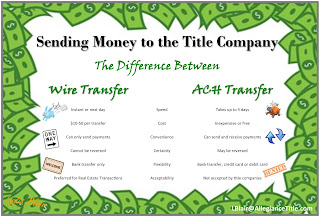
Wire transfers are electronic payments used to send funds directly from one entity’s bank account to another’s. With wire payments, funds are instantly accessible when they arrive in the payee’s bank account and the recipient can access the funds without delay.

Wires are often used for large transactions when reliability and speed are critical factors. Because of the speed, once funds have been wired, reversing the transfer is difficult if not impossible.

Wire transfers can include a cost to both the sender and the recipient. Wire transfer fees are set by each financial institution and range from $10 to $100 to send or receive a wire transfer.

Title companies warn clients that wire transmissions are often the target of scams. It is essential to confirm the person and account that the funds are being sent to prior to initiating a wire transfer. Wire instructions will always include the bank routing number, account number, and name of the party receiving the money.

Wire transfers are preferred by title companies for security and dependability. They are much better than cashier’s checks, which can take longer to process and have become easy to counterfeit.

ACH Transfer
An Automated Clearinghouse transfer, or ACH, also moves money electronically. This is similar to sending a check and is becoming more common as a means to replace paper checks. ACH transfers may be the system used if you have automated bill payments, direct payroll deposits, or make direct person-to-person payments through PayPal, Venmo, or another system.

ACH payments are typically best for frequent or recurring transactions where the amount is smaller. Consumers like them for recurring payments for utilities, loans, etc., and for payments for services like Uber. Both large and small businesses like ACH as an e-payment method in this digital economy. Money can be both sent and received with ACH transfers.

The lower cost makes an ACH an appealing option for most consumers. Most ACH transfers are free for the sender or cost just a few dollars. While ACH payments are less expensive, wire transfers are faster. 

The ACH network electronically processes transfers in large batches or groups to an automated clearinghouse, which sends them onto a bank. These can take a few hours or several days to complete and clear. The process is too slow for funding real estate transactions where time is of the essence. With a real estate sale, the closing is not complete and the property does not change ownership until all funds are confirmed and processed by the title company. ACH payments do not meet the definition of “good funds” per the Texas Insurance Code, Title XI, Section 2651.202. Sending the title company an ACH transfer for closing is a recipe for delays.

In addition to the time factor, title agents are averse to ACH transfers because they may be reversed. The criteria for stopping an ACH transfer is determined by each bank. 

When purchasing a property, always confirm that funds sent to the title company are via a confirmed wire transfer and not an ACH transfer. If your Bank of America rep tells you they are the same thing, they are wrong. Follow the title company instructions and remember that the task of getting good funds to the title company on time is the responsibility of the buyer.
[where: 75230]